Friday, 6 May 2011

Dalziel and Pascoe - The full bog roll years

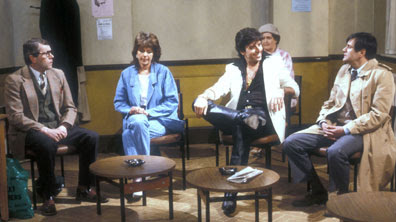
As the 12th and final series of my favourite cop show Dalziel and Pascoe has just been released on dvd, I thought I'd look back at the show in a three part article. This week I'll consider the early, great episodes. Then I'll look at the decline of the show in its later years and finally I'll review an episode (the worst one!) with which I have a bizarre fascination.

I came to the series late, catching it for the first time in the 4th series. The show holds the record for the fastest I've ever liked anything. I flicked on to it in mid-episode and in the five seconds I'd allocated before flicking elsewhere Warren Clarke looked at the screen with his bizarre one eye closed and the other eye boggling expression and said, "He's three sheets short of a full bog roll, that one." I was instantly hooked, but the story of the show began some time before that.

The format started life as Reginald Hill's novel series in the early 1970s, a series that's still on-going today. Sadly I have to admit I don't like the novels. I've tried a few and I really wish I'd liked them because I can see why many others love them. They are well-written, avoid the trapping of formula fiction by not having a formula, are complex and often take risks with fantastical plots. And yet the fact that the author never uses one word when several hundred will do has stopped me becoming an addict.

The hero of the books is Andy Dalziel, a fat, annoying, abrasive tyrant whose obnoxious persona is a façade to hide his keen detective mind. In my mind he's a cross between Columbo and Hank Quinlan from Touch of Evil. Helping him solve crimes in the fictional Yorkshire town of Wetherton is the wet behind the ears idealist officer Pascoe who would be destined for great things if he wasn't saddled with an annoying boss. Although it's a chalk and cheese relationship, the stories are cleverer than that.

In the early 90s ITV decided to make the novels into a tv series and in a terrible move someone thought they'd make a vehicle for the strangely popular at the time 'comedy' duo Hale and Pace. The pilot show was a stinker, getting a critical mauling from everyone including the author and so the idea was shelved. Luckily the BBC then bought the rights and in 1995 they gave the show the respect and budget it deserved. Over the next 12 years they made 46 full length movies.


Warren Clarke was cast as Dalziel and although I believe the author and some fans had misgivings about casting a thin man in a fat man's role, it rapidly became clear that an actor who'd been a droog in A Clockwork Orange could easily play an anti-hero. Amusingly the show often wrote in lines about him being fat and he was still referred to as the fat controller. With hindsight Warren was born to play this role with his lived-in face and easy Yorkshire wit (nobody ever succeeded with good looks and charm, Warren once said in a Blackadder episode).

Dalziel's character was neatly summed up by Dalziel himself in the opening episode: 'I use foul and abusive language. I pick my nose and I scratch my balls. I fart louder than is biologically necessary and I do it all in public. I've got sod all going on in my life, more's the pity, so I do my job, collect my wages, and go home for tea, generally in the middle of the night. And you'll already have seen I don't know any funny handshakes.'

I was never quite able to see Colin Buchanan's Peter Pascoe as being anything other than his Hodge from The Preston Front, which wasn't helped when co-stars from that show turned up in various episodes, but he provided an excellent foil to his boss. Also in the mix was Detective Wieldy, who managed to be one of the best-written gay characters on tv by the simple process of rarely mentioning that he was gay. There was also Novello (named Ivor by Dalziel) as a female detective who had little to do and so she was changed frequently without anyone particularly noticing. The other interchangeable roles were the shouty boss who never had anything to do other than shout at Dalziel and be the boss and the amusing pathologist who never had anything to do but be amusing in the morgue.

The characters were allowed to have private lives (which always plays well with me) with Pascoe's life mainly involving arguments with his miserable wife. Ellie Pascoe is the only thing I didn't like about the show. It was nice to see Steptoe's real life daughter on screen, but her role was thankless with her endless complaints about Pascoe coming home late and him not doing something more upwardly mobile with his life. Worse, she was a writer and so that meant she was always quoting from books and talking pretentiously about literature. I cheered when she left him.

Dalziel's private life mainly involved him arguing with old flames and then drinking (always Highland Park, my favourite whisky too) and smoking himself to death, and so he was always on the verge of collapsing from ill health. Several heart attacks and a shooting provided the very real risk that he wouldn't get to the end of some episodes, presenting a sense of danger for a weekly series. I wouldn't have been surprised if he had keeled over, and when the series went downhill I wished he had.


The stories, in the first seven series anyhow, were faultless with not a single bad episode. I've watched them all many times and I always find something new and interesting. The plots were as convoluted as you'd expect from a cop show with the ultimate solution to the murder involving such things as an evil twin feigning his death 40 years ago and then coming back from the dead disguised as... oh you know where this is going. But despite this, all the characters would be believable with nobody coming over as deadmeat character, femme fatale character, red herring character etc. Although if anyone understands the story with Tom Bell and Leslie Phillips and the secret moles staging a murder to cover up a real murder that never happened because everyone was busy framing someone for another murder I'd welcome an explanation.

Entertainingly Dalziel didn’t always solve the crime, but he could always be relied upon to offer plenty of wit over the corpses. And the show often played on his anti-hero status in which it was easy to believe he would do unthinkable things leading to stories that were never formulaic.

Although they had a huge range of styles and story types, the stereotypical Dalziel story involved a downbeat tale set in a dingy Yorkshire pit village where it never stops raining and it's always dark and the miserable 'around here we hate folks who ain't from around here' villagers who are all suffering from miners' lung disease huddle in the cold local working men's club dribbling into their empty glasses while a pervert plays with himself in the wood watching a local lass failing to pay off her impotent blackmailer and then kills a child and dumps her body down a mine shaft to cover up the fact he kicked a dog to death while Dalziel who is scratching his nuts at the time, gets told to sod off by his sister who refuses to tell him she's dying of cancer and so Dalziel drinks himself senseless and then kills someone while drunk driving while Pascoe is sent on a secret mission by shadowy forces that'll end his career no matter what he does in which he has to destroy Dalziel for taking backhanders during the miners' strike and then covering it up by killing the boss of the impotent blackmailer except Pascoe is too busy trying to stop his wife leaving him while his daughter lies dying in hospital so the only suspect hangs himself out of shame even though he didn’t do it and the only decent bloke in the whole episode drowns at the bottom of a pit and nobody notices. It's always fun to watch a cheery episode of Dalziel and then watch Morse immediately afterwards!

Anyhow, the first 25 or so films were as good as this sort of thing gets, but then it all went horribly wrong and although I loved the show to the end, I'll offer some thoughts on its decline next week.

Saturday, 30 April 2011

Review of The Secret of Devil's Canyon


I.J. Parnham presents the reader with a book that starts off like a straight-forward storyline but with the introduction of more and more characters, such as the bone-hunter Jim Dragon and his enemy Pierre Dulaine, and Emily Chambers who is searching for her missing father, all of whom seem to be involved in different threads to the story, it isn’t long before the plot throws up twist after twist that makes this book impossible to put down until the reader discovers how everything is resolved.

Read more at Western Fiction Review.

Thursday, 28 April 2011

Review of The Secret of Devil's Canyon


I love the cover to this book as it reminds me of the old pulps and Jeff Arnold and The Riders Of The Range Annuals. The Secret Of Devil's Canyon has Nathaniel McBain and Shackleton Frost escorting convicted killer Cooper Metcalf to the Bear Creek pen. Of course, the prisoner protests that he is innocent - and maybe he is but Mayor Maxwell is dead and his daughter, Narcissa, is missing believed killed...

Read more at Broken Trails.

Thanks, Ray.

And, in other news, I learnt today that Sheriff without a Star will be published in December.

Wednesday, 27 April 2011

A Fistful of Interviews


An informative three part interview with many of the contributors to the anthology A Fistful of Legends is available at Booklifenow.

Why do I like Westerns so much? Why do Western stories — the characters, the settings, the situations, the writing styles, the tropes - resonate so profoundly with me? Anthologies like Express Westerns’ A Fistful of Legends edited by Nik Morton and Charles T. Whipple always get me thinking about the power of Western fiction. Legends came out in 2009 and contains 21 original Western stories.

Read more: Part #1 / Part #2 / Part #3.

The anthology itself can be bought here.

Saturday, 23 April 2011

Dear John - John Sullivan's finest sitcom

By a horrible co-incidence I wrote the post below this morning aiming to come back to check for spelling later, by which time it'd been announced that the writer John Sullivan had died...

I've just watched the tv series Dear John for the first time in over 20 years and I was pleased that I enjoyed it as much as I remembered I had. I should say first that I'm talking about the UK series and not the US remake.


It was strange to see how the memory works in that I could remember very little of the specifics of the show and yet the moment an episode started I could remember the whole storyline and all the jokes. The two main things I knew in advance is that the sitcom is one of those very nearly great series. Only 14 episodes were made even though the format was good enough to run for a decade, but the tragic early death of the lead actor brought the series to a premature end. The other thing I knew is that it's strangely neglected. The writer John Sullivan's fame largely stems from his sitcom Only Fools and Horses, which is always voted as Britain's favourite sitcom while Dear John never gets a mention. Odd that.

Watching it again made me realize a few others things. I'm willing to lay a bet that the writers of Father Ted were Dear John fans. The character of John has a Ted quality (the only sane man in a world of idiots and whose only fault is not to know he's an idiot too) and there are other similarities in large and small ways. Humour often springs from John telling a small lie, and then when that's found out, he has to tell bigger and bigger lies to more and more people, which is something that Ted did a lot. Then there's the joke of the terrible disco with only one record that got re-used in Ted and Mrs Arnott, a character that get laughs because she never says anything feels like a trial run for Father Jack.


As for the characters, the down-at-heel and put-upon John is more interesting than I remembered. There's a darkness to his character after his divorce, perhaps helped by the fact Ralph Bates was such an odd choice to play a sitcom lead after starring in all those lurid Hammer horrors. It's good that everyone he rubs up against are unremittingly awful with a selfish ex-wife, and unpleasant friends who are worse than enemies. With such a terrible life, he seeks out solace in the 1-2-1 club where other sad divorcees join up to discuss their failings and annoy each other. First time round I was rooting for John to get together with Kate, but this time I found Belinda Lang's character to be horrible and there didn't seem to be any tension between them at all. She doesn't get any sympathetic lines and she disappears from the show before the end. Also Ralph, the sad loner whose only friend is his terrapin (which strangely hasn’t grown large like terrapins do), was also not as entertainingly dull as I remembered him to be. But then again there's a lot of competition in sitcoms for his type of character.


The undoubted star is Kirk St Moritz, a character who, if the series had gone on for longer, would have become a comedy great. He's a man without a single redeeming quality, being an arrogant, stupid, egotistical fantasist whose every line is crass and insulting. But what makes him so brilliant is that it's all an act and he's really a sad loner who lives at home with his mum (who for no good reason is Irish and sounds like Mrs Doyle from Father Ted) and who is essentially Ralph without the charisma. The fact that John knows this but can’t tell anyone is a comic set-up that could have been used dozens of time.

The other undoubted star is Louise, the leader of the group with her legendary catchphrase of 'were there any sexual problems?'. The glee on her face as she encourages people to bear their soul to ridicule is endlessly fascinating. Sadly though the series ended before it could get started, but 14 great episodes is better than most sitcoms manage in longer runs.

Tuesday, 19 April 2011

Woolly Maggots

One of the difficulties of living so far away from the place you write about is getting in the Wild West mood.


One small thing that helps me is that the local farmer usually puts cows in the field next to my house. After watching them waft at flies, belch, fart, and squirt vast streams of manure over each other for a few minutes I'm usually in the right frame of mind to, well, write about absolutely anything but cows. In fact, I've never felt an urge to write a cow drive story or a range war over cows story, and I blame it all on the smelly things outside my house.

But despite this the coming of the cows always cheers me as it says that spring is here. Except this year the farmer hasn't brought back the cows. Instead we have sheep and so I'm writing this with the window open and listening to a cacophony of baa, mer, meer, baaa, meerrr, meeerrr.


It's been only a few days, but already I'm disappointed in them. They do all the things that cows do, but so far none of them have behaved like my favourite sheep: Aardman's Shaun the Sheep. They've shown no inclination to build a light aircraft or to stand on top of each other to climb a tree. They just stand there looking gormless, falling into the brook and worrying passing dogs. On the other hand they're quite good at escaping overnight so perhaps when everyone goes to bed they form a sheepy pyramid to get over the fence.

Anyhow, I'm not sure yet if this'll affect my writing and whether I'll find it harder to get in the Wild West mood. Perhaps it'll make me want to write about cows.

Sunday, 17 April 2011

Beneath Dark Waters by Marcel Admiraal

I receive offers to review books on a fairly regular basis. Usually I quickly decline as my to be read pile has taken on a life of its own and currently looks like it might outlive me. But when Marcel Admiraal's collection of horror stories Beneath Dark Waters arrived in my in-box I realized I hadn't read any horror for years and I couldn’t resist having a look, and I was pleased I did as I read the tales in one sitting.


As the author is Dutch there are a few times when sentences lose something in the translation, but I enjoyed the tales enough for this not to matter. Marcel's stories have a gentle, old-fashioned structure that I like in horror in which real people are given time to find their voice before something nasty happens. And then the something nasty is revealed in creepy ways rather than as a gorefest of the kind that drove me away from reading horror in the first place. The tales have a sense of place, namely Holland, which is lovingly described and makes the situations all the more believable (I live in a flat, rural area so that added to the effect!).

Of the tales, Those Strange Beautiful Fishes is my favourite with its simple tale of a day spent fishing, except all is not as it seems...

You can read more about Marcel and his fiction at Floating Robes.