Showing posts with label Comedy. Show all posts

Friday, 11 May 2012

Episodes

The second series of Episodes starts tonight and I'm intrigued to see if any changes will be made. I enjoyed the first series, which was a promising one, but it was also frustrating as it never quite scaled the heights that it kept threatening to achieve. Although as the people behind the show are tv comedy veterans, I wonder if the show did exactly what it was intended to do, so the second series won't provide more focus on the bits that worked and instead will be pretty much the same as the first. Being contrary to expectations did appear to be the main focus of a show that started by deliberately adopting the worst possible title for Google searching.

The premise behind the show is a good one with plenty of material for humour, if anyone wants to use it. A couple, played by Stephen Mangan and Tamsin Greig, write a successful British sitcom that gets bought by an American studio that then hires them to write a new pilot in Hollywood. So, producers and writers and focus groups get their claws into the format. Within days Matt LeBlanc is hired to play the aged, overweight school-teacher previously portrayed by Richard Griffiths and bit by bit every single element that made the British sitcom good is removed to leave a program that bears no resemblance to the original.

Obviously this process has happened for real, such as Red Dwarf which generated a female cat, a hunky Rimmer and a non-smeggy version of Lister. Or Men Behaving Badly with Gary and Tony being executives living in a spacious apartment with glamorous girlfriends and who on no account ever behave badly. But the final punchline to this process is that despite a few groan-inducing failures, nine times of out ten the US produce sitcoms that are funnier than UK ones. So a UK / US co-production with this premise can mine plenty of cross Atlantic, culture clash humour about the differing approaches, except strangely it didn't.

Aside from a brief chat about American sitcoms needing to create a premise that'll work for 200 episodes while UK ones only need to cope with about 20 episodes, there's little focus on the actual mechanics of writing. There's a running gag involving a terrible producer doing terrible British accents and making terrible decisions, and quite a bit of time is wasted poking fun at Hollywood excesses, which is a subject that doesn’t travel well. But for the most part the show is a warm drama in which the three leads either bond or argue, and the best comedy comes from Matt either living up to his Joey 'how you doing?' image or playing against it. Taken as light drama with some mildly funny character exchanges played out in awkward situations created by crass and insensitive people, the show works much better than as the sitcom about a sitcom it's billed to be.

Series 2 continues the story after the pilot, against all expectations and justice, has been aceepted for a full run and, with the show already having burnt its bridges (and the stated rules for the sitcom within a sitcom) by resolving the will they / won't they aspect of the story, it'll be interesting to see where they take it.

Saturday, 23 April 2011

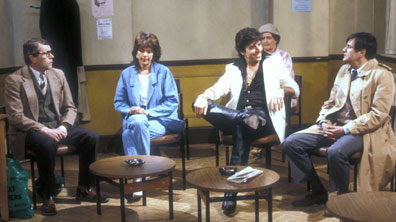
Dear John - John Sullivan's finest sitcom

By a horrible co-incidence I wrote the post below this morning aiming to come back to check for spelling later, by which time it'd been announced that the writer John Sullivan had died...

I've just watched the tv series Dear John for the first time in over 20 years and I was pleased that I enjoyed it as much as I remembered I had. I should say first that I'm talking about the UK series and not the US remake.


It was strange to see how the memory works in that I could remember very little of the specifics of the show and yet the moment an episode started I could remember the whole storyline and all the jokes. The two main things I knew in advance is that the sitcom is one of those very nearly great series. Only 14 episodes were made even though the format was good enough to run for a decade, but the tragic early death of the lead actor brought the series to a premature end. The other thing I knew is that it's strangely neglected. The writer John Sullivan's fame largely stems from his sitcom Only Fools and Horses, which is always voted as Britain's favourite sitcom while Dear John never gets a mention. Odd that.

Watching it again made me realize a few others things. I'm willing to lay a bet that the writers of Father Ted were Dear John fans. The character of John has a Ted quality (the only sane man in a world of idiots and whose only fault is not to know he's an idiot too) and there are other similarities in large and small ways. Humour often springs from John telling a small lie, and then when that's found out, he has to tell bigger and bigger lies to more and more people, which is something that Ted did a lot. Then there's the joke of the terrible disco with only one record that got re-used in Ted and Mrs Arnott, a character that get laughs because she never says anything feels like a trial run for Father Jack.


As for the characters, the down-at-heel and put-upon John is more interesting than I remembered. There's a darkness to his character after his divorce, perhaps helped by the fact Ralph Bates was such an odd choice to play a sitcom lead after starring in all those lurid Hammer horrors. It's good that everyone he rubs up against are unremittingly awful with a selfish ex-wife, and unpleasant friends who are worse than enemies. With such a terrible life, he seeks out solace in the 1-2-1 club where other sad divorcees join up to discuss their failings and annoy each other. First time round I was rooting for John to get together with Kate, but this time I found Belinda Lang's character to be horrible and there didn't seem to be any tension between them at all. She doesn't get any sympathetic lines and she disappears from the show before the end. Also Ralph, the sad loner whose only friend is his terrapin (which strangely hasn’t grown large like terrapins do), was also not as entertainingly dull as I remembered him to be. But then again there's a lot of competition in sitcoms for his type of character.


The undoubted star is Kirk St Moritz, a character who, if the series had gone on for longer, would have become a comedy great. He's a man without a single redeeming quality, being an arrogant, stupid, egotistical fantasist whose every line is crass and insulting. But what makes him so brilliant is that it's all an act and he's really a sad loner who lives at home with his mum (who for no good reason is Irish and sounds like Mrs Doyle from Father Ted) and who is essentially Ralph without the charisma. The fact that John knows this but can’t tell anyone is a comic set-up that could have been used dozens of time.

The other undoubted star is Louise, the leader of the group with her legendary catchphrase of 'were there any sexual problems?'. The glee on her face as she encourages people to bear their soul to ridicule is endlessly fascinating. Sadly though the series ended before it could get started, but 14 great episodes is better than most sitcoms manage in longer runs.

Saturday, 28 March 2009

Colonel Potter's love of westerns

As I'm starting to get into the mood to watch American 1970s sitcom M*A*S*H again, I've been reminded of Colonel Potter. This character, as played by veteran actor Harry Morgan, was the only main character in the series I didn't like. It's probably not his fault as I tended to find him annoying when he turned up in western films and shouted a lot for no good reason.

The main problem though was that he took over command of the M*A*S*H unit from Henry Blake, one of my favourite sitcom characters. For the first three seasons of the series Blake, who essentially wandered around in a clueless fog while avoiding making decisions, was the perfect comic creation. The actor's timing was astounding, especially when giving orders to Radar, a man who can predict exactly what Blake is going to say and do before being given the order.

Blake was less successful at pretending to be drunk or clumsy, which he had to do in every episode, but when he left the series and was written out by being killed off, he traumatised viewers, probably for all time. I know I've still not got over it!


So to replace Blake was an impossible task and in fairness they didn't try. This was one of the strengths of the series and it probably helps to explain why it ran for so long. The womanizing Trapper was replaced with the family-man BJ. The bumbling idiot Frank Burns was replaced with the skilled but pompous Winchester, and Hotlips in a bad move was replaced with Margaret Houlihan, but I digress.

So for the new commander of the unit in season four we got the opposite of the permanently bemused Blake in the form of army career officer and former cavalryman Potter. Sadly for continuity obsessives like me this ignored the fact that the actor had played a barking-mad general in an episode of season three.

Potter was a version of the Harry Morgan western role of the old cowboy who yells a lot and says Horse Hockey. I never found a single thing he did amusing or found his character particularly believable as such a stickler for discipline would never cope with the rest of the characters and their antics. But I did like it that he read westerns. In fact, unless anyone can tell me otherwise, I don’t think any other series character has ever been shown so often engrossed in a western novel nor so often been heard to say how much he loves reading a good western. For the record his favourite writer was Zane Grey.

Potter's finest western moment came in the episode Movie Tonight. For my money this is the best episode of M*A*S*H as it perfectly distilled everything the series was about. In it, the doctors and nurses are more depressed than is usual after a lull in the fighting leaves them sitting around getting on each others' nerves. So to cheer them up Potter hires his favourite western movie My Darling Clementine for the whole unit to see.


Nobody is particularly enthused and they attend the film in a bad mood. When the film keeps breaking down it only adds to everyone's annoyance. So to while away the time while Klinger rethreads the film they recreate the OK Corral shootout, Hotlips sings, Radar does some movie-star impressions, and generally all the actors and actresses do their little party pieces.

Despite everything, everyone ends up having a good time. This is the only youtube clip I could find of this episode, including the sublime punchline where Frank Burns, with impeccable timing and a complete disregard for the prevailing spirit, chips in with his own verse:

Hawkeye and B.J. think they're pretty smart. I'd like to take a scalpel and stab them in the heart.

So all together now : I don't want no more of Army life, gee, Ma, I want to go home.

Saturday, 21 March 2009

Tucker from Citizen Smith

This is the first in a series of occasional articles celebrating a few less well-documented western moments. Some might be well-known, some less so, most perhaps ought to be forgotten, and all add absolutely nothing to the rich history of the western, but they have entertained me.

The first subject is the character of Tucker from British sitcom Citizen Smith, a cowboy so obscure I had to scan my dvd to get an image of the actor Tony Millan.
The British sitcom ran in the late 1970s and was the first work by popular tv writer John Sullivan, the man behind such standard British classics as the unfortunately never-off-the-tv Only Fools and Horses and the sadly never-on-the-tv Dear John. I think the appeal of his shows lies in that they usually feature 'ordinary' working people at the bottom of the pile, rather than the middle-class angst-ridden characters in most British sitcoms or the successful high-achievers of American sitcoms.

I have mixed feelings about most of his comedies, but I did enjoy the earlier work of Citizen Smith, a show that appears to have been largely forgotten, despite the fact that its subject matter is, as they say, as relevant today as it was then, perhaps even more so. In it Wolfie Smith is a low-life, a marxist revolutionary determined to smash the establishment and herald in a workers' paradise.
Not surprisingly the workers' champion doesn't actually work himself. And despite being in essence a terrorist he keeps our sympathy by the fact that he's a bumbling fool, whose plans always fail. In his attempts to bring in the Glorious Day, he's helped by his long-suffering girlfriend (or at least he was until their real-life marriage ended and she left the show), his Buddhist chum Ken, a Nazi thug Speed, and Tucker, the cowboy.

Tucker was the only character I particularly remember from when it was first shown 30 odd years ago, although having seen it again on dvd recently I'm not sure why. Throughout the whole run, Tucker wears cowboy clothes. I must have missed the explanation at the time as I'd often wondered why (well, not that often!). But in the first episode the explanation is that he works at a Wild West restaurant, serving John Wayne Steaks and Alamo Burgers. Why he dressed as a cowboy the rest of the time was explained in the final season as simply, he enjoyed it.

The joke, as such, was that for a character who dresses as a rough, tough Wild West cowpoke, he's completely the opposite. He's always the first to run away, always voting against any of Wolfie's schemes if they sound in the least bit dangerous, and he speaks every single line with either a dreary dull tone or a scared and shaking one. Oh and the other Tucker joke is his vast family of at least 9 children. Although in an early outing for that perennial favourite sitcom joke, we never get to see his wife, but we do get to hear a catalogue of bizarre things about her.

I'm not saying this is a classic series, but it did manage about 30 laughs during its 30 episodes, which is a high rate for British sitcoms. And it did include a rare cowboy character on a British-made tv series, even if the reason wasn't a particularly good one.

Anyhow, I struggled to find a youtube clip from the show (proving I guess that it is a forgotten show) but found this, which by Sod's Law has to be the only moment in the whole series where Tucker isn't wearing a cowboy hat, but then again the 'plot' does call for it. Here the lads are busy trying to bring down civilization as we know it by hijacking a lift.